
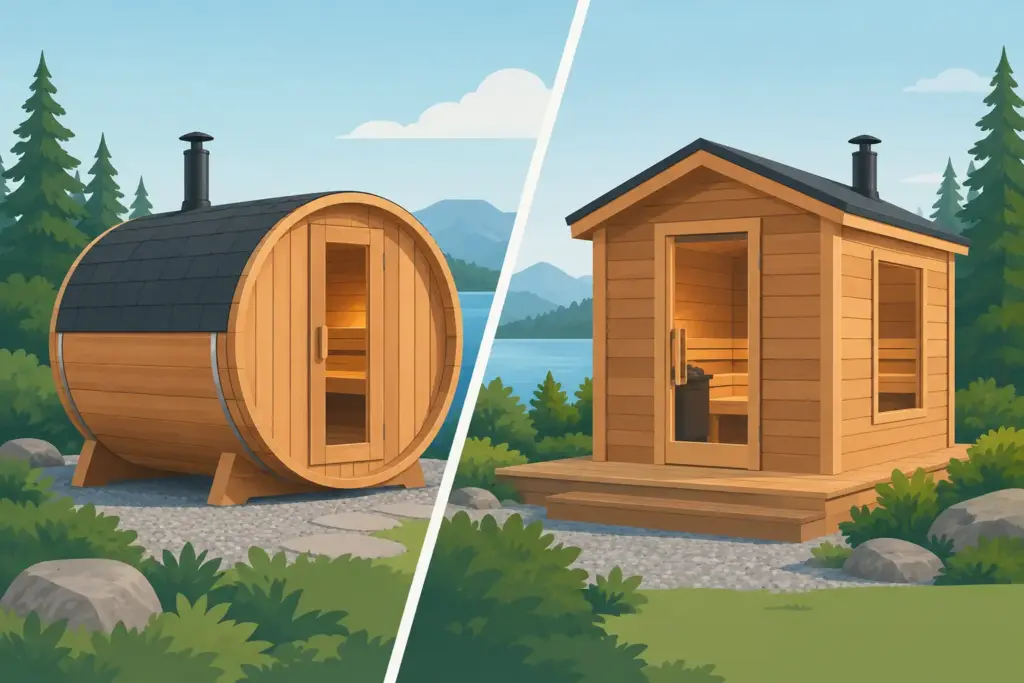
A sauna can become the most-used wellness space on your property, but only if its shape works for the way you live. The barrel sauna versus cabin sauna decision is not just an aesthetic choice. It affects how the sauna heats, how many people can use it comfortably, where it can sit, and whether you will still love it after years of rainy weekends, winter sessions, and regular recovery routines.
Both formats can deliver an excellent traditional sauna experience when built with quality materials, proper ventilation, and a capable heater. The better choice comes down to your site, household, preferred heat source, and expectations for comfort. That is why Select Saunas follows a Zero Junk approach: details such as lumber quality, door construction, bench layout, heater compatibility, and weather protection matter far more than a product photo.
Barrel Sauna Versus Cabin Sauna: The Core Difference
A barrel sauna uses curved staves to form a rounded cylinder, typically with benches along both sides and a heater near the entrance. It is recognizable, efficient, and especially popular for backyard installations. The curved roof naturally sheds rain and snow, while the compact interior can heat quickly because there is less unused air space above the bathers.
A cabin sauna is a traditional rectangular structure with vertical walls, a flat or pitched roof, and more flexible interior dimensions. It can resemble a small backyard building, a garden room, or a compact retreat beside a cold plunge. Cabin models usually offer more freedom in bench configuration, changing areas, windows, covered porches, and larger multi-person layouts.
Neither style is automatically better. A barrel sauna is often the right answer for a couple seeking a distinct outdoor sauna with efficient heating and a smaller footprint. A cabin sauna is often the stronger long-term fit for families, frequent hosts, or buyers who want a roomier layout and more architectural control.
Heat Performance and Sauna Feel
The rounded interior of a barrel sauna minimizes the volume of air the heater must warm. In practical terms, that can mean a faster warm-up compared with a similarly sized rectangular sauna, particularly when the barrel is appropriately insulated or used in moderate conditions. Its shape also encourages heat to circulate around the room.
Still, faster is not always the deciding factor. A cabin sauna generally has more vertical wall area and can support higher upper benches. Since heat rises, bench height plays a major role in the quality of a traditional sauna session. A well-designed cabin can place bathers higher in the heat zone, allowing a more consistent and intense experience across the upper bench.
This is where specifications matter. Do not judge heat performance by the exterior size alone. Look at interior cubic footage, heater output, insulation, wall construction, ceiling height, window area, and climate. A premium electric heater from Harvia, HUUM, Saunum, or another established manufacturer can transform the experience, but it still needs to be correctly sized for the sauna and its glass surfaces.
Wood-Burning or Electric Heat
Both barrel and cabin saunas can work beautifully with electric or wood-burning heat. An electric heater is convenient for homeowners who want predictable controls, scheduled sessions, and less hands-on preparation. It is often the practical choice near the house, in a home gym setting, or wherever proper electrical service is available.
A wood-burning stove brings ceremony, radiant heat, and off-grid flexibility. It is especially appealing at cabins and rural properties. Cabin saunas may provide more planning flexibility for stove clearances, chimney routing, and wood storage, but many barrel models are purpose-built for wood-fired use as well. Local codes, safe clearances, chimney components, and a stable noncombustible base should guide the decision.
Space, Seating, and Everyday Comfort
Barrel saunas make smart use of a compact footprint, but their curved walls shape the seating experience. Most have opposing benches, which creates a friendly, face-to-face layout for two to four people. For couples, that is often ideal. You get an efficient sauna that feels cozy rather than oversized.
The trade-off is flexibility. Curved sidewalls can limit headroom at the outer edges, and bench depths may be narrower than those in a generously sized cabin sauna. If you are tall, prefer lying down between rounds, or expect multiple adults to sauna at once, study the interior dimensions rather than relying on the stated capacity. A claimed six-person sauna may technically hold six people, but that does not mean six adults will have the relaxed elbow room they expect.
Cabin saunas shine when comfort is the priority. Their square walls allow for straight, deeper benches, L-shaped or tiered seating, and more useful shoulder room. They are often easier to configure for four, six, or eight users. Some designs also include a changing room or vestibule, which is valuable in cold climates because it reduces heat loss when the exterior door opens.
For a household that will use the sauna several times a week, choose based on your real routine. Consider who will use it, whether they will sit or lie down, where towels and water will go, and whether guests will join often. The best sauna is not the one with the biggest capacity claim. It is the one that feels inviting enough to use regularly.
Weather Protection and Long-Term Placement
A barrel sauna is naturally well suited to exposed outdoor locations. Its rounded profile moves water off the roof rather than allowing it to collect, and its compact form can look at home beside a patio, pool, lakefront, or garden. A barrel also gives a backyard an unmistakable sauna identity without requiring a large structure.
That does not mean it is maintenance-free. Outdoor wood needs ongoing care. Depending on the species, finish, exposure, and local climate, you may need to apply a suitable exterior protectant and keep the base area dry and well drained. A quality barrel sauna should sit on a stable, level foundation that keeps the wood out of standing water.
Cabin saunas require more roof planning, but they can offer better weather management in severe climates when properly built. A pitched roof, overhangs, exterior cladding, and insulated wall systems can provide substantial protection from wind, snow, and repeated freeze-thaw cycles. If your property sees heavy snowfall or driving rain, these construction details deserve close attention.
Cabin designs also blend more easily with a home’s architecture. A modern backyard may call for clean lines and glass, while a rustic property may favor a cedar structure with a porch. A barrel creates an intentional focal point. A cabin can feel like a natural extension of the property. Your preference is valid, but make sure the design complements the usable space rather than overwhelming it.
Installation, Foundation, and Access
Many barrel saunas arrive as kits or preassembled units, depending on the model. Their relatively simple form can make them appealing for homeowners who want a straightforward outdoor installation. Yet delivery access is critical. Measure gates, paths, corners, slopes, and overhead obstacles before choosing a fully assembled sauna.
Cabin saunas can involve more assembly and may require a more substantial base, particularly for larger models with porches or changing rooms. They reward that planning with a more customizable footprint. If you are building a full wellness area with a cold plunge, outdoor shower, and lounge space, a cabin can serve as the anchor for the entire setup.
For either format, start with the site. Verify a level foundation, electrical requirements, drainage, setbacks, delivery route, and any HOA or local permitting considerations. Never assume that an outdoor sauna can simply sit on grass or loose pavers. A properly prepared base protects the structure, supports the heater installation, and helps doors operate correctly through changing seasons.
Which Sauna Should You Buy?
Choose a barrel sauna if you want a compact, distinctive outdoor sauna for one to four regular users, value fast heating, and like the look of curved cedar in a backyard setting. It is an especially strong fit for couples, recovery-focused homeowners, and properties where a compact standalone structure makes sense.
Choose a cabin sauna if you want more spacious seating, higher bench potential, a changing area, stronger architectural integration, or frequent use by family and guests. It is often the better investment for buyers who want the sauna to function as a true outdoor room rather than a compact heat retreat.
Quality should be the final filter. Premium lumber, reliable heaters, correctly engineered ventilation, safe clearances, and a manufacturer with a proven track record will have more impact on ownership satisfaction than shape alone. A hand-picked sauna from an established brand gives you a better starting point than a bargain model with vague construction details.
Before you place an order, stand in the intended location and imagine the routine: walking out after work, warming up after a workout, stepping in from a cold plunge, or sharing a session with family on a winter night. The sauna that fits that moment best is the one worth bringing home.
Leave a Reply