
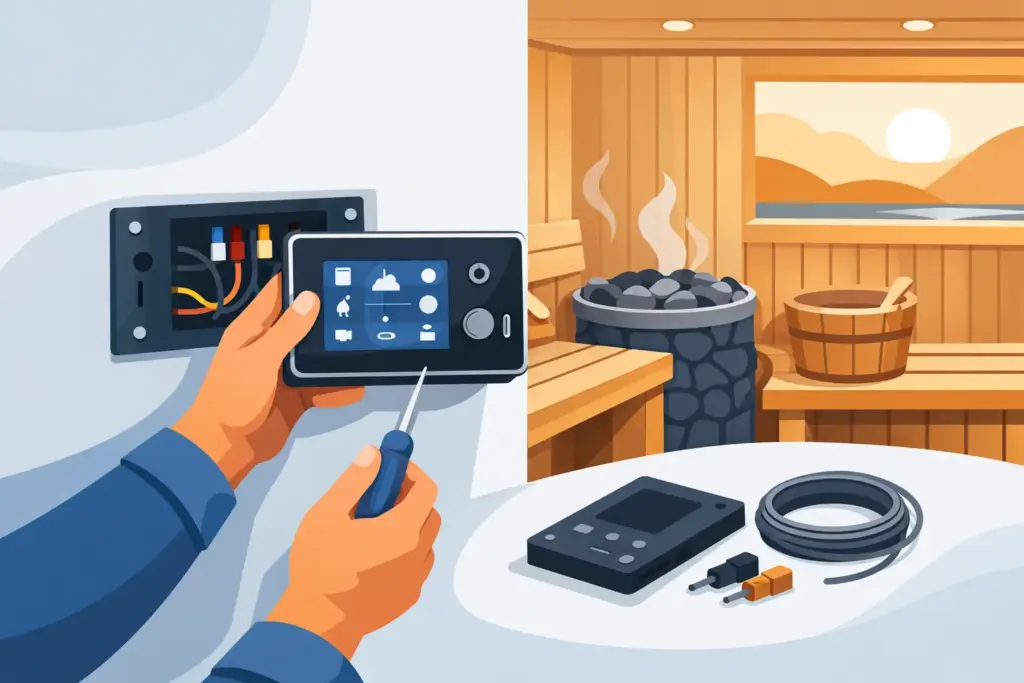
A blank display, a timer that will not hold its setting, or a sauna that suddenly refuses to heat can make a premium home wellness space feel unusable fast. A sauna control panel replacement may be the answer, but the panel is not a universal switch you can swap by appearance. It is the command center for the heater, temperature sensor, safety limits, lighting, and sometimes ventilation or Wi-Fi functions.
The right replacement restores the sauna experience you invested in. The wrong one can create wiring conflicts, false temperature readings, nuisance shutdowns, or damage to the heater control system. Before ordering anything, identify the original system and determine whether the panel itself is truly the failed component.
Start With Diagnosis, Not the Replacement Part
A control panel is often blamed because it is the visible part of the system. Yet a nonresponsive screen can also be caused by a tripped breaker, loose connection, failed power supply, damaged communication cable, tripped high-limit switch, or a heater issue. On an infrared sauna, a failed controller, relay board, or heating panel may produce similar symptoms.
Begin with the basics. Confirm that the sauna has power at the breaker and disconnect, if applicable. Check whether the control panel powers on, whether it displays an error code, and whether the heater makes any response when you start a session. Record the exact code or behavior before resetting anything. That detail can save a great deal of guesswork.
If the display works but the sauna will not heat, the failure may be downstream from the panel. If the display is completely dead while the electrical supply is confirmed, the panel, cable, or transformer becomes more likely. A panel that turns on but reports unrealistic temperatures may point to a sensor or sensor wire rather than the keypad itself.
This is where brand-specific troubleshooting matters. Harvia, HUUM, Saunum, Finnmark, Dynamic, Golden Designs, and other established manufacturers use different control architectures. Even within one brand, controls can vary by heater generation, voltage, sauna type, and feature package.
What Must Match in a Sauna Control Panel Replacement
The safest path is to replace a failed control with the same manufacturer-approved model or an explicitly compatible successor. A modern panel may look nearly identical to the original and still be incompatible with its control unit, heater, or sensors.
Before selecting a sauna control panel replacement, gather the control panel model number, heater model number, serial number if available, and clear photos of the display, control box, and wiring labels. Also confirm whether your sauna is traditional electric, wood-fired with electronic accessories, infrared, or hybrid. These systems do not use controls interchangeably.
Heater and control-box compatibility
Many traditional sauna systems have two separate components: the wall-mounted user interface and a control unit that manages heater power. Replacing only the wall panel may solve a damaged display or keypad issue, but it will not repair a failed control unit. Conversely, a new control package may include both pieces and require updated sensors or cables.
The heater model and output matter. A control designed for a smaller heater may not be rated for a higher-kilowatt unit. Controls also differ in their support for contactors, remote start, lighting circuits, ventilation, and optional mobile app functions. Do not assume that an upgraded touchscreen can operate every older heater.
Voltage, wiring, and installation location
US residential sauna heaters may use 120V, 208V, 240V, or other configurations depending on the equipment and installation. The control system must match the heater’s electrical requirements and the wiring already in place. This is not an area for trial and error.
Panel placement also matters. Some controls are designed for installation outside the sauna room, while others are rated for a specific mounting location or enclosure. Heat, steam, and moisture can shorten the life of a control that is installed where it was never intended to operate.
Sensors and safety devices
Temperature sensors, overheat protection, door switches, and limit controls are part of the system’s safety design. A replacement panel may require a particular sensor type, cable length, or mounting position. Reusing an older sensor is sometimes acceptable when the manufacturer allows it, but it is not always the best move.
If a system is repeatedly tripping its high-limit protection, do not bypass the switch or treat it as an inconvenience. A recurring high-limit trip can indicate improper sensor placement, a stuck relay, blocked airflow, wiring trouble, or a heater problem that needs qualified service.
When an Upgrade Makes Sense
Replacing like for like is usually the simplest and most cost-effective choice. An upgrade can be worthwhile, however, when the original control is obsolete, the display has limited features, or you are modernizing the sauna during a heater replacement.
A newer control may add delayed start, preset session profiles, more precise temperature settings, lighting control, remote monitoring, or app connectivity. Those features are appealing, especially in a backyard sauna or dedicated recovery space. But convenience should not outrank compatibility and safe installation.
Remote-start capability deserves extra care. Safety standards and manufacturer instructions may require a door sensor, a check of the sauna room before starting, or other safeguards. A sauna should never be remotely activated without following the system’s approved safety requirements. If children, guests, or pets could access the sauna, those precautions become even more important.
For many homeowners, a complete matched control package is the cleanest answer when the existing system is dated or multiple components have failed. It costs more than a display-only replacement, but it can eliminate uncertainty around old cables, sensors, and control-box compatibility.
Installation Is an Electrical and Warranty Decision
Replacing a simple low-voltage display cable may be straightforward for a handy owner when the manufacturer provides clear instructions. Work inside a line-voltage control box, heater junction box, or service disconnect is different. Electric sauna heaters draw significant power, and improper wiring can create shock, fire, equipment-damage, and warranty risks.
Turn off power at the breaker before opening any electrical enclosure. Verify that power is off with appropriate test equipment rather than relying on the panel display. Follow the control manufacturer’s wiring diagram exactly, including conductor sizing, grounding, sensor routing, and separation between low-voltage communication wiring and power conductors.
For a hardwired heater or a control-box replacement, a licensed electrician familiar with sauna equipment is the sensible choice. If the sauna is still under warranty, confirm the approved service process before ordering parts or disconnecting original components. Some manufacturers require diagnosis through an authorized dealer or technician, and unauthorized modifications can affect coverage.
Avoid the Universal-Control Trap
Online marketplaces make it easy to find inexpensive “universal” sauna controllers. That label should make a premium sauna owner cautious. A generic controller may lack the correct safety logic, sensor compatibility, electrical rating, certification, or manufacturer support for your equipment.
Saving money on the panel can become expensive if it damages a heater, causes unreliable operation, or leaves you without meaningful warranty support. The control is not an accessory like a headrest or thermometer. It is a safety-critical part of the sauna system.
Select Saunas follows a Zero Junk approach for the same reason: a sauna is a long-term home investment, and the components behind the wall should meet the same quality standard as the sauna you see and use. Choosing a hand-picked, manufacturer-supported replacement gives you a much better chance of restoring reliable heat rather than creating a second repair project.
A Better Way to Order the Correct Control
Have the model information ready before you shop or request help. Include the sauna brand, heater brand and model, control model, approximate installation year, voltage, and the exact problem. Photos of labels and error messages are especially useful because a single letter or revision number can change compatibility.
Ask whether you need the panel only, a panel and cable, a new sensor, or a complete control package. Also ask whether the existing control box can support the replacement and whether professional installation is recommended. These are practical questions, not unnecessary upsells.
If the original part is discontinued, do not settle for the closest-looking option. Request the approved replacement path for your specific heater. A proper successor may involve an adapter, updated sensor, revised control box, or a full kit designed to bring the system up to current specifications.
A sauna should feel simple once it is ready: set the temperature, allow the room to warm, and enjoy the heat with confidence. Taking a little extra time to verify the control system now protects that simplicity for years to come.
Leave a Reply