
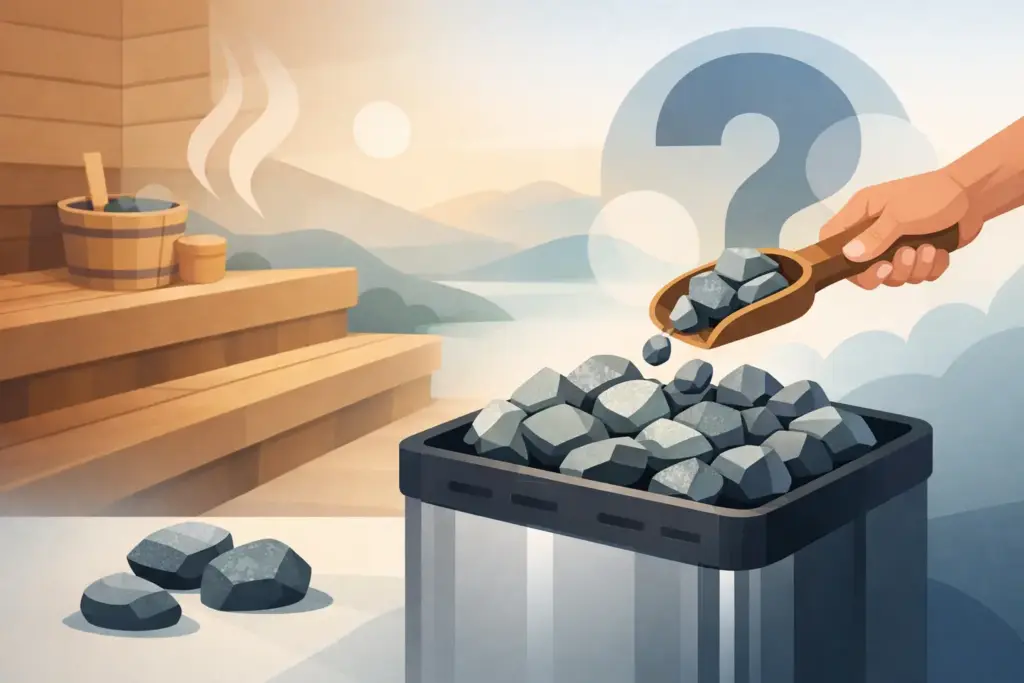
A heater can have the right kilowatt rating and still deliver disappointing heat if its stone compartment is loaded incorrectly. When homeowners ask how many sauna stones needed, the best answer is not a single bag count. It is the amount of sauna-grade stone your specific heater is designed to hold, arranged so heat and air can move freely through the basket.
For a premium home sauna, stones do far more than make an electric heater look finished. They store heat, soften the heat cycle, and create the satisfying burst of steam you get when water reaches hot stone. Get the load right, and your sauna feels even, responsive, and built for the ritual. Get it wrong, and you risk weak löyly, slow recovery between water throws, or premature stress on the heating elements.
How Many Sauna Stones Are Needed? Start With Heater Capacity
Your heater’s installation manual is the final authority. Manufacturers specify a stone capacity in pounds or kilograms because the basket, elements, airflow pattern, and safety clearances were engineered as one system. That stated capacity is your target, not an optional maximum to ignore.
A compact wall-mounted heater for a two-person indoor sauna may call for roughly 35 to 50 pounds of stone. A mid-size heater commonly used in a four-person sauna may take 50 to 100 pounds. Larger floor-standing heaters and high-capacity models can hold 150 pounds, 200 pounds, or considerably more. Tower heaters from respected brands such as Harvia and HUUM often use a tall, open stone column, so their stone capacity can be dramatically greater than a conventional wall heater of similar electrical output.
That difference matters. A heater holding 40 pounds of stone heats up quickly and works beautifully for a smaller sauna used by one or two people. A heater holding 200 pounds has much more thermal mass, which can produce gentler, longer-lasting steam and recover better during a family sauna session. More stones are not automatically better, though. The heater must be designed to heat that volume.
If you are replacing stones, use the manufacturer’s rated capacity as a practical purchasing number. Buy enough to fill the basket properly, with a small allowance for sorting out damaged pieces or unsuitable shapes. Do not cram extra stones into the heater simply because they fit physically.
Why Stone Quantity Changes the Sauna Experience
Sauna stones act as a heat battery. The elements heat the stone mass, then the stones release that energy gradually into the room. When you ladle water over them, the water flashes into steam and creates the humid heat traditional sauna owners expect.
Too few stones leave exposed elements and reduce the heater’s ability to retain heat. The room may still warm up, but the experience can feel sharp, dry, and inconsistent. Water can also pass too quickly through gaps and reach the lower parts of the heater rather than vaporizing across hot surfaces.
Too many stones create a different problem. Overpacking can block airflow through the heater, trapping excessive heat around the elements. Electric heaters need ventilation through the stone bed to operate as intended. A tightly packed basket can extend warm-up time, reduce efficiency, trigger high-limit protection, and shorten element life.
The goal is not a perfectly solid pile. It is a full stone compartment with intentional air channels. Think secure and stable, not compressed.
Stone Size Matters as Much as Total Weight
Most quality sauna heaters use a mix of medium and larger stones. Larger pieces create the structural base, while medium stones fill the spaces without choking off airflow. Very small stones, gravel, landscaping rock, river rock, and decorative stone do not belong in a sauna heater.
Sauna-specific stones are selected to tolerate repeated high-heat cycles and rapid cooling from water. Ordinary rocks may contain moisture pockets or mineral structures that cause cracking, crumbling, or in rare cases, sharp fragments when heated. This is one of those accessories where a hand-picked, correct product protects the investment you made in the heater.
Follow the size range in your heater manual whenever it is listed. As a general approach, place the largest stones at the bottom and around the element supports, then set medium stones loosely above them. Avoid wedging stones directly against heating elements or forcing pieces into narrow gaps.
Electric and Wood-Burning Heaters Need Different Approaches
Electric sauna heaters are the most exacting about stone arrangement because their elements run through or beneath the basket. Stones should rest naturally, never press hard against the coils, and leave enough open space for air circulation. After loading, look through the basket from several angles. You should see that the stones are supported and the elements are not bent, pinched, or buried under a packed wall of rock.
Wood-burning sauna stoves usually place their stone load on top of the firebox. Their required quantity still comes from the stove manufacturer, but the loading method is often more straightforward: stable, heat-resistant stones arranged so they do not interfere with the flue, door operation, or stove ventilation. A larger stone mass can be especially rewarding in an outdoor cabin or barrel sauna, where users may enjoy longer sessions and more frequent water throws.
Do not assume stones for an electric heater and a wood stove are interchangeable based only on appearance. Capacity, stone size, and placement instructions vary by model. For a new sauna build, select the heater first, then buy stones to match that heater rather than trying to make an existing stone supply work.
A Practical Way to Calculate Replacement Stones
If the original stones are gone and you do not know your heater’s capacity, first identify the heater’s make and model from its data plate. The model number is usually found on the side, back, or lower portion of the unit. That is far more reliable than estimating based on the sauna room size.
Once you have the specified capacity, convert it into bags based on the package weight. For example, a heater requiring 132 pounds of stone needs just under three 44-pound boxes. In practice, buying three boxes gives you enough material to choose well-shaped stones and replace any pieces that arrive chipped. A 100-pound requirement may call for two 50-pound boxes, while a 44-pound compact heater typically needs one matching box.
If your manual gives kilograms, multiply by 2.2 to estimate pounds. A 20-kilogram requirement is about 44 pounds, and a 60-kilogram requirement is about 132 pounds. Round up only to the next full package, not far beyond the heater’s stated limit.
There are a few situations where an exact capacity cannot be treated as a bag-shopping formula. Decorative cage heaters, tall tower heaters, and models designed for exposed stone surfaces may have specific layering instructions. Likewise, replacement stone sets sometimes include multiple sizes selected for a particular heater design. In those cases, choose the approved set rather than mixing random bag sizes to reach a weight target.
How to Load Sauna Stones Safely
Start with the heater completely cool and disconnected from power at the breaker. Remove any old stones and inspect the heater before loading. If you find warped elements, heavy scale, loose connections, or corrosion, address that issue before adding fresh stones.
Rinse new stones to remove packing dust, then allow them to dry. Place larger, stable stones first, especially around lower supports. Continue upward with medium stones, turning each piece until it sits naturally. Do not strike stones into position, force them between elements, or create a tightly interlocked layer that prevents air movement.
When the basket is full to the manufacturer’s intended level, check that the heater’s stone guard or top cover fits correctly. Run the heater for its first cycle according to the manufacturer’s instructions. A faint mineral smell or residue burn-off can occur with new stones, so ventilating the sauna during that first heating cycle is sensible.
When to Replace Sauna Stones
Stones do not last forever. Repeated heating and water exposure eventually cause them to crack, flake, and settle more tightly around the elements. For a frequently used home sauna, inspect them at least once a year. Replace broken or crumbling pieces and restack the remaining stones to restore airflow.
Full replacement timing depends on use. A sauna used several times each week may benefit from fresh stones every one to two years. A lightly used residential sauna may go longer, provided the stones remain solid and the heater is heating normally. If warm-up suddenly takes longer, steam feels weak, or you see a buildup of stone fragments at the bottom of the heater, it is time to inspect the load.
A well-loaded heater is one of the simplest ways to protect a premium sauna experience. If you know the heater model but are unsure which stone quantity or size belongs in it, Select Saunas can help you match the right sauna-grade stones to the equipment you own. The right load lets your heater do what it was built to do: deliver steady heat, clean steam, and a sauna session worth stepping away from the day for.
Leave a Reply